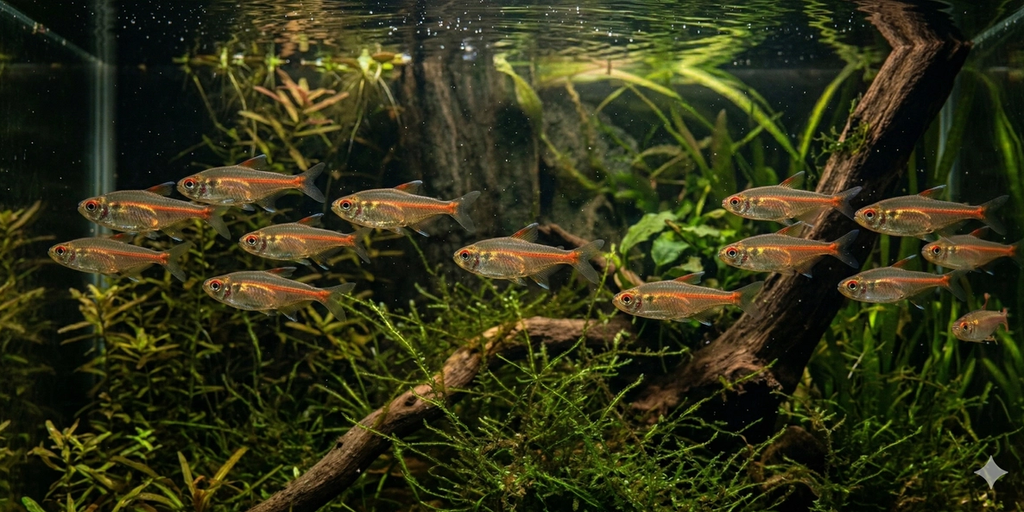
Glowlight tetras are peaceful schooling fish best known for the bright orange stripe that looks like it’s glowing, especially over dark substrate and greenery. They thrive in planted community aquariums with stable water quality, gentle-to-moderate filtration, and a proper school size. A larger group improves confidence and makes the schooling display more impressive. With compatible tankmates and consistent maintenance, they are hardy, beginner-friendly fish that look best in groups.
Quick Specs
Water parameters
| Temperature: | 72–80°F (22–27°C). Keep it stable; they are adaptable and do well in typical tropical community conditions. |
| pH: | 6.0–7.5 (slightly acidic to neutral; stability matters most). |
| Hardness: | 2–15 dGH (soft to moderately hard). |
| Other: | Ammonia and nitrites must be 0 ppm at all times. Keep nitrates low (ideally under ~20–30 ppm) with regular water changes and controlled feeding. Glowlights are generally hardy, but they show best color and calm behavior in a mature tank with stable parameters and a proper school size. |
| Water changes: | Change about 20–30% weekly to maintain stable water quality. In smaller tanks or heavier stocking, 15–20% twice weekly can improve stability and keep nitrates down. |
Behavior & compatibility
Schooling Behavior: Glowlight tetras are schooling/shoaling fish and should be kept in groups. In a proper school they are calmer, more confident, and show synchronized mid-water movement.Temperament: Glowlight tetras are generally peaceful and not typical fin-nippers. Occasional chasing can happen within the school, but serious aggression is uncommon in a proper group and spacious tank.
Centrepiece: They are not a single centerpiece fish, but a larger school can be a bright, peaceful feature in a planted community tank.
Prolific or Livebearing:They are egg layers (not livebearers). They may spawn in mature planted tanks, but they are not typically prolific in community setups because eggs/fry are usually eaten unless separated.
Swimming zone:They are mid-water fish that spend most of their time schooling in the middle and upper levels, especially during feeding.
Interaction with Plants:Excellent with plants and completely plant-safe. They behave best in planted tanks with open swimming space in the middle and cover around the edges.
Setup essentials
Lid: A tank cover is preferred. They can jump when startled, and a cover reduces evaporation and helps keep conditions stable.Filter: A filter is necessary. Use stable biological filtration with gentle-to-moderate flow to keep water clean without stressing the school.
Substrate: Dark sand or fine gravel is preferred, especially in planted tanks. Dark substrate reduces stress and makes the orange ‘glowline’ stand out more.
Lighting: Special lighting isn’t required, but moderate aquarium lighting is preferred for viewing and plant growth. Glowlights often look best with a darker substrate/background and some shaded areas.
Heater: A heater is preferred to maintain stable tropical temperatures (22–27°C), especially in cooler rooms or during seasonal swings.
Air Pump: An air pump is not strictly necessary if the filter provides good surface agitation, but gentle aeration is preferred in warmer tanks, higher stocking, or if oxygen seems low.
Feeding Regimen
Feed 1–2 times per day in small portions. They accept quality flakes and micro pellets as staples and do very well with frozen/live foods (daphnia, brine shrimp, bloodworms) a few times per week. Avoid overfeeding to protect water quality.Lifespan
With proper care, glowlight tetras typically live about 3–5 years.Tank Mates
Good tank mates
peaceful community fish (harlequin rasboras, cardinal tetras, rummy-nose tetras), corydoras, kuhli loaches, otocinclus, bristlenose pleco (space dependent), honey/pearl gouramis (in appropriate tanks), snails, many shrimp (adult shrimp usually fine).
Avoid
fin-nippers (tiger barbs/serpae tetras), aggressive cichlids, and very boisterous fish that stress them.
Note
keep them in a proper school and provide plants/cover—this improves confidence and coloration.
Common problems + quick fixes
Increase school size (8–12+), add plants/cover, use darker substrate/background, and keep water quality stable.
Use a mature cycled tank, acclimate slowly, and keep ammonia/nitrite at 0 with stable temperature.
Reduce feeding, improve filtration, and do consistent 20–30% weekly water changes (or smaller changes twice weekly).
Add plants (especially along edges), provide shaded areas, and reduce harsh lighting.
Interesting Facts
The “glow” stripe can look dramatically brighter under certain aquarium lighting and against dark backgrounds. Glowlights often become much more confident and visible when kept in larger schools rather than small groups. In planted tanks, they tend to patrol open mid-water lanes while using plant edges as a “safety zone.”