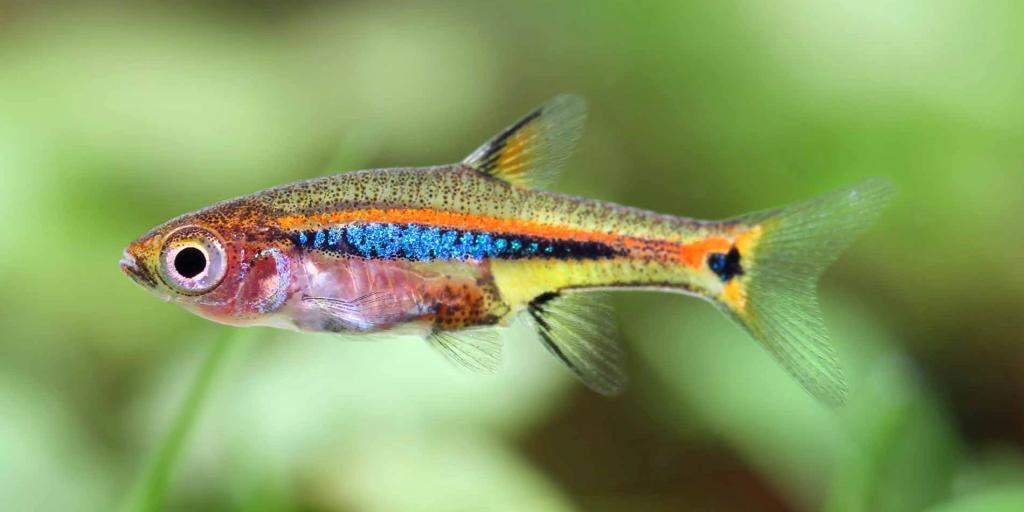
Least Rasbora (commonly sold as Boraras urophthalmoides, sometimes called the “Exclamation Point Rasbora”) is one of the smallest schooling fish commonly kept in aquariums. It is peaceful and best kept in calm, heavily planted setups where it feels secure. Like other Boraras, it tends to be shy and pale in small groups, but becomes more active and shows better color when kept in a larger school. It does especially well in mature nano tanks with stable water quality and gentle filtration. Because the fish is tiny, it can be stressed by strong currents and intimidated by larger or fast tankmates. It also needs very small foods and can be outcompeted at feeding time in mixed communities. Dense plants, moss, driftwood, and a darker substrate help reduce stress and encourage natural behavior. This species is a great choice for planted nano aquariums and blackwater-inspired layouts. With steady maintenance and stable parameters, a group becomes a lively mid-water feature that adds subtle movement and micro-scale beauty.
Quick Specs
Water parameters
| Temperature: | 72–82°F (22–28°C), stable and warm. |
| pH: | 5.0–7.5 (soft/acidic preferred; stability matters most). |
| Hardness: | 1–10 dGH (soft to moderately soft preferred). |
| Other: | Ammonia and nitrites must be 0 ppm at all times; nitrates should be kept low (ideally under ~20 ppm) through regular water changes, controlled feeding, and stable filtration. |
| Water changes: | Typically change 20–30% weekly to keep water quality stable. In small tanks or with heavier stocking, smaller changes twice per week (e.g., 15–20% twice weekly) can be even better than one larger change. |
Behavior & compatibility
Schooling Behavior: Least rasboras are tiny schooling fish that feel safest in larger groups; bigger groups encourage natural shoaling and reduce hiding. Least rasbora (Boraras urophthalmoides) should be kept in groups (minimum 10; ideally 15–18 for best display).Temperament: Centrepiece or Aggression or Fin-Nipping: Least Rasboras are peaceful, not aggressive, and not typically fin-nippers. They are more likely to be stressed by aggressive or fast tankmates than to cause issues themselves.
Centrepiece: Least Rasboras are generally not a single “centerpiece” fish; instead, a larger school becomes the visual feature through subtle color and group movement.
Prolific or Livebearing:They are egg-scatterers and not livebearers. They may spawn occasionally in mature planted tanks, but they are not typically prolific in community setups unless breeding is intentionally supported.
Swimming zone:Least Rasboras primarily occupy the middle to upper water levels and are active mid-water swimmers rather than bottom-dwellers.
Interaction with Plants:Dark, fine substrate (sand or planted soil) is preferred. Dark substrate reduces stress, enhances contrast and coloration, and pairs well with planted/blackwater layouts; optional leaf litter also works well.
Setup essentials
Lid: A tank cover is preferred because they can jump when startled, and it also reduces evaporation and helps keep temperature stable.Filter: A filter is necessary. Use a gentle filter (sponge filter is ideal) because strong flow can stress them, and stable biofiltration is critical for nano fish.
Substrate: Dark, fine substrate (sand or planted soil) is preferred. Dark substrate reduces stress, enhances contrast and coloration, and pairs well with planted/blackwater layouts; optional leaf litter also works well.
Lighting: Moderate aquarium lighting is preferred—mainly to support live plants and normal viewing. They don’t require intense light; floating plants can help diffuse brightness.
Heater: A heater is preferred and can be necessary if room temperature does not reliably keep the aquarium within 22–28°C. Stability is more important than chasing an exact number.
Air Pump: An air pump is not strictly necessary if the filter provides good surface agitation, but gentle aeration is helpful (preferred) in warm tanks, very still water, or heavily planted setups at night.
Feeding Regimen
Feed 1–2 times per day in small portions. Preferred foods are tiny: micro pellets, crushed flakes, baby brine shrimp, daphnia/cyclops, and microworms. Spread food across the surface so all fish get a chance to eat.Lifespan
With proper care, Least Rasboras typically live about 3–5 years.Tank Mates
Good tank mates
Tiny calm nano fish (chili/phoenix rasboras, ember tetras), pygmy Corydoras, otocinclus, shrimp/snails.
Avoid
Larger or pushy fish, fast feeders, fin nippers, and anything that stresses very small nano fish.
Note
Very small—feed micro foods and keep in a well-planted, stable aquarium.
Common problems + quick fixes
Dense plants + floaters + proper group size.
Use very small foods; feed slowly in calm water.
Add a sponge prefilter on the intake.
Interesting Facts
The “exclamation point” look comes from a dark spot near the tail and a darker mark toward the front, which can resemble punctuation when viewed on a pale body. They often show best behavior and confidence in darker, heavily planted or blackwater-style tanks with gentle flow. Because they’re tiny, feeding micro-foods and distributing food widely helps ensure the whole school eats.