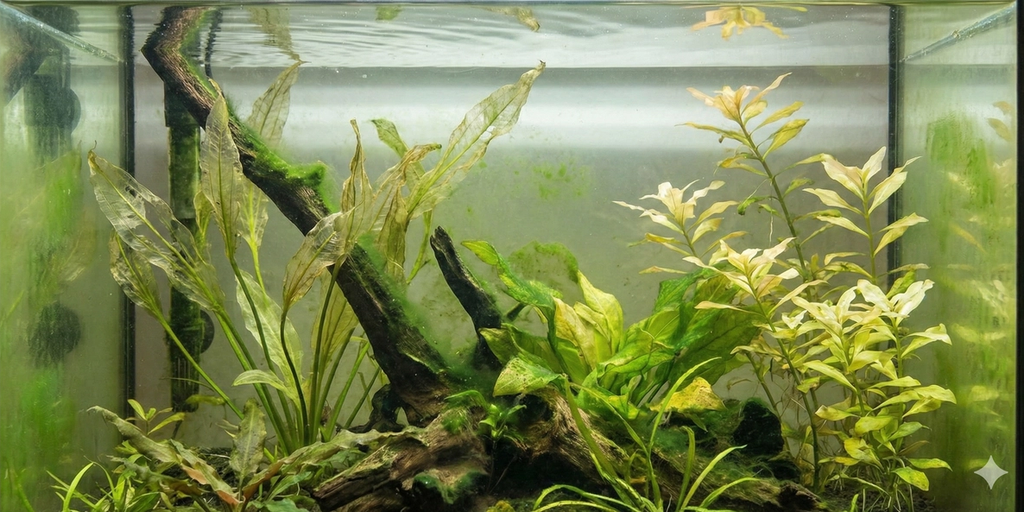
Aquarium plants make tanks look better and help water quality - but beginners often run into the same frustrating issues: plants “melt,” algae explodes, or nothing grows. The good news: most problems come from a few predictable mistakes. Fix those, and planted tanks get much easier.
1) Mistake: Thinking “plant melt” means the plant is dying
Plant melt is common after planting—especially with store-bought plants grown emersed (above water). When you submerge them, old leaves can die back while new underwater growth replaces them.
What to do
- Don’t rip the plant out right away.
- Remove fully decaying leaves, but keep healthy roots/rhizome.
- Give it 2–4 weeks to adapt before judging.
- If it’s a rhizome plant (Anubias, Java fern), don’t bury the rhizome—attach it to wood/rock.
Red flag: if the base turns mushy quickly and the whole plant collapses, it’s often poor planting technique or poor water circulation, not “normal melt.”
2) Mistake: Planting incorrectly (the most common cause of failure)
Many beginner plant deaths are just “wrong planting.”
Common errors
- Burying rhizome plants (Anubias/Java fern) → they rot.
- Planting stem plants too shallow → they float out.
- Planting too deep (burying crowns) → rot.
- Putting heavy root feeders in inert substrate with no root tabs → stunted growth.
Fix
- Learn the plant type:
- Rhizome plants: attach, don’t bury.
- Stem plants: plant stems 2–3 cm deep, spaced, trim tops and replant later.
- Rosettes (crypts, swords): bury roots, keep crown above substrate.
3) Mistake: Too much light (algae magnet)
Beginners often buy a strong LED and run it too long. Plants can’t use unlimited light without enough CO₂ and nutrients—algae will use the excess.
Fix
- Start with 6–8 hours/day.
- If algae appears, reduce to 6 hours for 2 weeks.
- Avoid direct sunlight hitting the tank.
- Use floating plants to naturally soften light.
Rule of thumb: if plants aren’t growing fast, don’t increase light—first fix nutrients and stability.
4) Mistake: Not understanding nutrients (NPK + micros)
Plants need:
- Macros: Nitrogen (N), Phosphorus (P), Potassium (K)
- Micros: iron and trace elements
In many beginner tanks, one of these becomes limiting.
Common symptoms
- Yellowing leaves = often nitrogen or iron issue (context matters)
- Pinholes = often potassium
- Stunted new growth = often micro deficiency or lack of CO₂/stability
Fix
- Use a simple all-in-one fertilizer for low-tech tanks.
- If you have inert substrate and root feeders (crypts/swords), add root tabs.
- Don’t “chase numbers” daily—dose consistently and observe weekly.
5) Mistake: Ignoring CO₂ (even in “no CO₂” tanks)
You don’t need injected CO₂ for many plants, but CO₂ availability still matters. Surface agitation, plant mass, and fish load affect it.
Fix
- For low-tech tanks: keep moderate surface movement (oxygen) but avoid “whitewater” turbulence that drives CO₂ off too aggressively.
- Choose plants that thrive without injected CO₂ (crypts, anubias, java fern, vallisneria, many mosses).
6) Mistake: Adding too many plants… or too few
Both cause problems:
- Too few plants + strong light = algae wins.
- Too many demanding plants in a new tank = slow growth + melt + algae.
Fix
- Start with easy, fast growers to outcompete algae:
- stem plants, vallisneria, floaters
- Add slower plants (anubias, java fern) after stability improves.
7) Mistake: Not cycling / unstable tank parameters
Plants can handle a lot, but unstable ammonia/nitrite, inconsistent temperature, or big swings in water chemistry can trigger melt and algae.
Fix
- Make sure the tank is properly cycled.
- Keep maintenance consistent (weekly water changes are fine).
- Avoid huge changes in lighting, fertilizers, or hardscape all at once.
8) Mistake: Cleaning “too well” (removing what plants need)
Beginners sometimes over-clean:
- scrubbing everything weekly
- deep vacuuming planted areas
- changing filter media too often
This disrupts stability and can slow plant recovery.
Fix
- Vacuum only where debris collects (not deep in planted roots).
- Rinse filter media in old tank water only when flow drops.
- Let the tank mature—planted tanks improve with time.
9) Mistake: Fighting algae the wrong way
Algae is a symptom of imbalance—usually light vs. nutrients vs. plant growth.
Better approach
- Reduce light duration to 6 hours
- Add fast-growing plants or floaters
- Dose fertilizer consistently (don’t stop completely)
- Remove algae manually (quick wipe + prune affected leaves)
- Keep maintenance steady for 2–3 weeks
If you change everything at once, you can’t tell what helped.
Quick troubleshooting checklist
If plants are melting or algae is growing, check these in order:
- Light duration: 6–8 hours
- Plant type planted correctly (rhizome not buried)
- Nutrients: consistent all-in-one + root tabs if needed
- Tank stability: cycled, steady temp, steady routine
- Add fast growers / floaters to beat algae