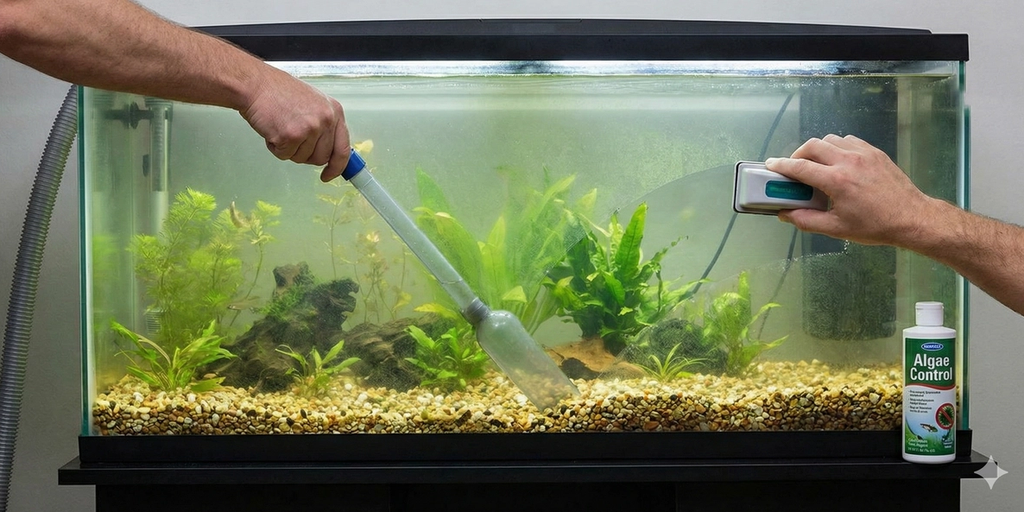
Algae happens-even in well-kept aquariums. The mistake is thinking you need to tear everything down. In most cases, you can get algae under control in 7–14 days by fixing the imbalance that’s feeding it and making plants (or beneficial bacteria) win again.
This guide is a practical “do this first” plan that works for most beginner tanks.
The core idea (why algae shows up)
Algae is almost always caused by an imbalance of:
- Light (too strong or too long)
- Nutrients (too much or too little relative to plant growth)
- Plant mass / competition (not enough fast growers)
- Maintenance consistency (waste buildup, unstable routine)
You don’t need a reset—you need to reset the balance.
Step 1: Remove algae manually (fastest visible improvement)
Do this once right away:
- Wipe glass with sponge/magnet.
- Pull or trim the worst algae-covered leaves.
- Use a toothbrush to twist off hair algae from plants/decor.
- Siphon loose algae and debris during a water change.
Why this matters: removing algae reduces spores and stops it from shading plants.
Step 2: Cut light to 6 hours/day (immediate leverage)
For the next 10–14 days:
- Set lighting to 6 hours/day.
- Avoid direct sunlight hitting the tank.
- Don’t increase brightness to “help plants” during algae outbreaks.
If your light is very strong, lowering intensity (if possible) helps too—but duration is the first lever.
Step 3: Do 2 quick water changes in the first week
- Day 1: 30–40% water change (after manual removal)
- Day 4–5: 25–30% water change
Then return to weekly changes.
Bonus: siphon areas where waste collects (but don’t deep-vacuum planted roots).
Step 4: Stop overfeeding (most common root cause)
For one week:
- Feed slightly less than usual.
- Remove uneaten food after a few minutes.
- If fish are healthy, it’s fine to skip one day of feeding.
Overfeeding = more waste = more algae fuel.
Step 5: Increase plant “competition” (the clean solution)
Algae loses when plants grow fast. Add one or two of these:
- Floating plants (very effective)
- Fast-growing stem plants
- Vallisneria / similar easy growers
Even if you don’t want a heavily planted tank long-term, using fast growers temporarily is one of the quickest algae fixes.
Step 6: Don’t “zero out” fertilizers (common beginner mistake)
If you have live plants and you’re dosing fertilizer:
- Don’t stop completely (plants stall, algae wins).
- Dose consistently but modestly for 2 weeks.
If you have no plants:
- Nutrients mainly come from food/waste, so focus on feeding + water changes.
Step 7: Fix the filter basics (without nuking bacteria)
- Don’t replace all filter media.
- If flow is weak, rinse sponges/media in old tank water.
- Make sure filter runs 24/7.
- Ensure good circulation (no stagnant corners).
A clogged filter + low flow = waste pockets = algae hotspots.
Step 8: Match the fix to the algae type (quick reference)
Green dust algae (film on glass)
- Reduce light to 6 hours
- Wipe glass every 2–3 days
- Usually improves in 1–2 weeks
Hair algae / string algae
- Manual removal + trim affected leaves
- Reduce light + stop overfeeding
- Add fast growers/floating plants
Brown algae (diatoms)
Common in new tanks:
- Wipe it off, keep routine stable
- It often fades as the tank matures
- Avoid over-lighting “to fight it”
Blue-green algae (cyanobacteria)
Not true algae; treat as a warning sign:
- Increase flow and oxygenation
- Manual removal + larger water changes
- Reduce excess organics (waste/overfeeding)
A simple 7-day action plan
Day 1
- Manual removal + 30–40% water change
- Set light to 6 hours
Day 2–3
- Feed lightly
- Remove visible algae spots
Day 4–5
- 25–30% water change
- Rinse filter media in old tank water if flow is low
Day 6–7
- Keep light at 6 hours
- Add/trim fast-growing plants if you can
Then continue 6-hour lighting for another week before slowly moving to 7–8 hours if plants are thriving.
What NOT to do (causes repeat outbreaks)
- Don’t restart the tank (you lose stability).
- Don’t replace all filter media.
- Don’t run lights 10–12 hours “for plants.”
- Don’t change five things at once every day.