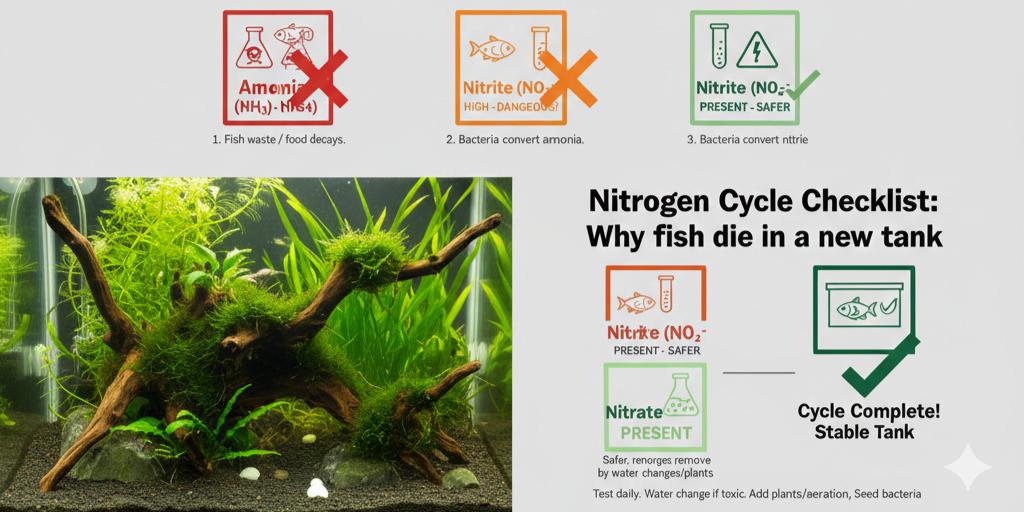
Most “mystery deaths” in a brand-new aquarium come down to one thing: the biofilter isn’t established yet, so ammonia and/or nitrite spike (“new tank syndrome”). During cycling, test results usually progress ammonia → nitrite → nitrate, and fish can be harmed or killed before the tank can process waste.
What’s happening in a new tank (in plain terms)
In a mature aquarium, beneficial bacteria in the filter and on surfaces convert:
- Ammonia (fish waste/uneaten food) →
- Nitrite →
- Nitrate (removed mainly via water changes and plants)
In a new tank, these bacteria populations are still growing, so ammonia and nitrite can reach toxic levels.
Important detail: ammonia is more dangerous at higher pH and higher temperature because more of it is in the toxic form (NH₃).
Nitrogen cycle checklist (use this when fish are dying)
A) Test the right things (don’t guess)
Use a reliable liquid test kit and check:
- Ammonia (NH₃/NH₄⁺)
- Nitrite (NO₂⁻)
- Nitrate (NO₃⁻)
A tank is commonly considered “cycled” when ammonia = 0 and nitrite = 0, and nitrate is being produced.
B) Spot the classic “new tank” mistakes
- Added fish too soon (running the tank 24–48 hours is not cycling).
- Added too many fish at once (bacteria can’t keep up).
- Overfeeding (rotting food = ammonia).
- Filter issues: turned off too long, cleaned media in tap water, replaced all media at once (kills bacteria colony).
- Dechlorinator missed/underdosed: chlorine/chloramine can damage gills and harm biofilter bacteria (always treat new water).
C) Confirm the “invisible killers”
If fish are gasping, clamping fins, lethargic, or dying quickly:
- Assume ammonia/nitrite poisoning until tests prove otherwise.
If there are already fish in the tank: emergency actions
- Immediate water change (30–50%) with dechlorinated, temperature-matched water.
- Stop or reduce feeding for 24–48h (most fish tolerate this; it reduces ammonia input).
- Increase aeration (air stone / surface agitation), especially during nitrite issues.
- Test daily and repeat water changes as needed until ammonia and nitrite stay at 0.
- If possible, seed beneficial bacteria (cycled filter media from a healthy tank). Cycling bacteria are slow-growing, so time and stability matter.
(If ammonia is present and your pH is high, urgency is higher because toxicity increases with pH/temperature.)
How long should cycling take?
Many guides put cycling around ~3–8 weeks depending on temperature, bioload, seeding, and method; others cite ~4–6 weeks as common.
Don’t use the calendar alone—use test results.
Prevention (the “do this next time” list)
- Fishless cycle before adding livestock (or add very slowly and test frequently).
- Add fish gradually (small bioload steps).
- Never replace all filter media at once; rinse media in tank water, not tap.
- Always dechlorinate new water.
- Keep parameters stable (temperature swings + unstable pH make stress worse).