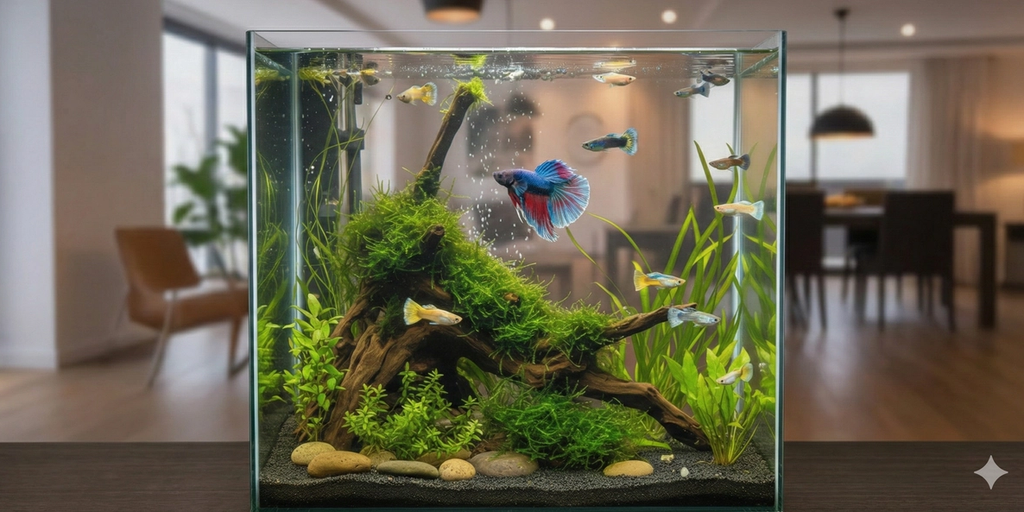
Yes—sometimes. But it’s not a “safe by default” combo, especially with a male betta and male fancy guppies. The main risks are fin-nipping (guppies) and aggression/territorial attacks (betta). If you try it, you need the right tank size, the right fish selection, and a backup plan.
Quick verdict
- Not recommended in small tanks (like 5–10 gal / 20–40 L).
- Possible in 20 gal long (75 L) or larger, planted, with careful fish choices.
- Highest-risk pairing: male betta + male fancy guppies (bright colors + long fins).
- Lower-risk pairing: calmer betta (often female) + female-only guppy group in a well-planted tank.
Why this pairing is tricky
1) Guppies may nip betta fins
Guppies are curious and can become fin-nippers—long, flowing betta fins are an easy target (especially if guppies are hungry, crowded, or stressed).
2) Betta may attack guppies
Bettas are territorial. Bright, flashy guppies (especially males) can trigger chasing and biting.
3) Water-parameter overlap is “okay,” but not perfect
Bettas do well in warm tropical water; guppies also like warm water, but guppies often do best in harder, more alkaline water than what many betta keepers aim for. You can keep both healthy by prioritizing stability and staying in the shared comfort zone. Betta temperature range commonly cited is 22–30°C. Guppy temperature guidance commonly cited is around 72–82°F (22–28°C).
“Green-light” checklist (when it’s most likely to work)
Aim to meet all of these:
Tank & layout
- Tank size: 20-gallon long (75 L) minimum, bigger is better.
- Heavily planted with line-of-sight breaks (tall plants, wood, rocks).
- Gentle flow (bettas dislike strong current).
- Multiple hiding spots + at least one calm “betta zone.”
Fish selection
- Betta: choose a calm individual if possible (avoid known aggressive behavior).
- Guppies: prefer female guppies (less flashy) or short-finned types.
- Avoid very colorful, long-tailed male guppies—those are most likely to be chased.
Stocking style
- Keep guppies in a proper group (they’re social), but avoid overcrowding.
- Do not mix male and female guppies unless you’re ready for constant fry.
Step-by-step setup that gives you the best chance
- Start with a mature tank (stable cycle, consistent temperature).
- Add guppies first and let them settle for 1–2 weeks.
- Rearrange decor right before adding the betta (reduces territorial “ownership”).
- Add the betta with lights dimmed, feed everyone, then observe closely.
- Watch for the “first 48 hours” signs:
- Bad signs: relentless chasing, torn fins, guppies pinned to corners, betta refusing to eat.
- Good signs: short curiosity + disengaging, everyone returns to normal swimming.
Non-negotiable: have a plan B (a spare tank, divider, or rehoming option).
Temperature, pH, and what to actually target
Instead of chasing “perfect” numbers, aim for:
- Temperature: ~25–26°C (77–79°F) (good overlap for both).
- pH: keep it stable; bettas (especially captive strains) can tolerate neutral-ish water well, and many care guides put them around neutral as a practical target.
(If your water is very soft/acidic, guppies may struggle long-term; if it’s very hard/alkaline, most bettas can still do fine if stable—individual variation matters.)
Better alternatives (if you mainly want a “community” tank)
If your goal is a peaceful community, bettas are usually more reliable with tank mates like small rasboras, some tetras, and corydoras-type bottom fish depending on tank size and temperament.
Summary
- Can they live together? Yes, but not reliably.
- Best chance: 20 gal long+, heavily planted, female guppy group, calm betta, and a backup plan.
- Avoid: male betta + flashy male guppies, small tanks, sparse decor.