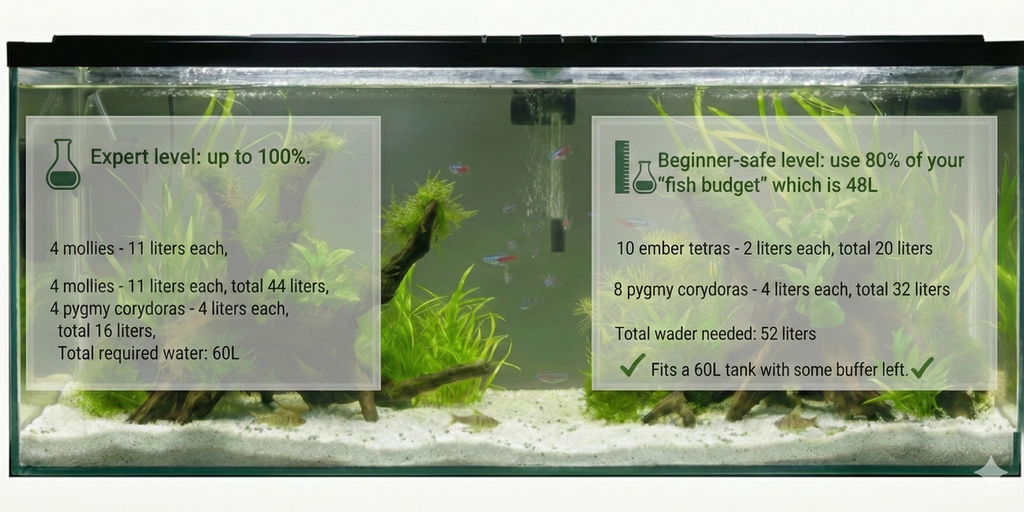
A 60-liter aquarium (approximately 15-16 US gallons) is a good “small but not tiny” aquarium. It is large enough to provide a stable water environment and a good community, but still small enough so that overstocking occurs quickly.
The following is a simple guideline you can follow, along with actual examples you can copy.
A simple rule that actually works
Rule #1: Start with water per fish (bioload + space)
As a simple rule for newbies, you can follow these steps to plan your aquarium:
Total water requirement = Σ (number of fish * water per fish)
Then keep a safety buffer:
- Beginner-safe level: use 80% of your aquarium space
→ If your aquarium has 60L, your “fish budget” will be 48L - Expert level: up to 100% if filtration + maintenance are strong
→ Your aquarium has 60L, and your “fish budget” will be 60L
This rule is simple, and it helps you avoid the most common mistake for newbies.
Important: this is a planning heuristic. Real stocking also depends on filtration, live plants, oxygen, and how messy the fish are.
Quick conversion: 60L in gallons
- 60 liters ≈ 15.9 US gallons (call it 16 gal)
Examples of stocking that would fit a 60L tank
Example A: Peaceful Nano Community - a good community for a beginner
- 10 ember tetras - 2 liters each, total 20 liters
- 8 pygmy corydoras - 4 liters each, total 32 liters
Total water needed: 52 liters
✅ Fits a 60L tank with some buffer left.
Why this stocking works: small fish, peaceful, good water column and bottom coverage.
Open this setup in Virtual Aquarium
Example B: Livebearer setup (active fish, plan for stability)
- 6 endler’s livebearers - 3 liters each, total 18 liters
- 8 pygmy corydoras - 4 liters each, total 32 liters
Total required water: 50L
✅ Fits a 60L tank with some buffer left.
Tip: males-only endlers are simplest (no surprise fry).
Open this setup in Virtual Aquarium
Example C: Danio + cory setup (more movement, still stable)
- 9 celestial pearl danios - 3 liters each, total 27 liters
- 8 pygmy corydoras - 4 liters each, total 32 liters
Total required water: 59L
Tip: use plants/wood to break up line-of-sight and keep the tank feeling calm.
Open this setup in Virtual Aquarium
Example D: One centerpiece fish
- 1 betta - 19 liters each, total 19 liters
- 10 ember tetras - 2 liters each, total 20 liters
Total required water: 39L
✅ Fits — but only if the betta’s temperament allows tank mates.
Tip: have a backup plan (separate tank or return option) in case the betta is aggressive.
Open this setup in Virtual Aquarium
Example E: Active schooling fish (you run out of space faster)
- 10 zebra danios - 6 liters each, total 60 liters
Total required water: 60L
✅ Fits, but it’s a “full tank” stocking level.
Tip: danios are very active. A longer tank footprint is better than a tall tank.
Open this setup in Virtual Aquarium
A few beginner mistakes to avoid
“They’re small, so I can add a lot”
Small fish still produce waste. A lot of small fish can overload filtration and create unstable water in a 60L.
“I’ll just take the max requirement of one species”
No - you add the requirements because you’re adding bioload and activity:
- If 4 mollies need 44L and 8 pygmy corydoras need 32L, you need 44 + 32 = 76L, not 44L.
“I’ll stock all at once”
Even with a cycled tank, add fish in steps:
- Week 1: first group
- Week 2-3: second group
This keeps bacteria and water stability from crashing.
The quickest way to calculate your exact stocking
Just use our Virtual Aquarium tool: enter your tank size, choose fish species, and set the quantity for each fish. It will instantly calculate:
- Total water required for your selected stocking
- Minimum recommended group size for schooling/shoaling fish (so you don’t under-stock species that should be kept in groups)
- A combined suitable temperature range based on the fish you selected (helpful for building compatible communities)
- A quick check for obvious mismatches (for example, mixing species with very different temperature needs)
This is the most convenient way to play with various fish combinations, such as tetras and corys, livebearers, and betta tanks, without any calculations.
Quick checklist for a thriving 60L Community Tank
- Tank is cycled (ammonia and nitrite levels = 0)
- Filter is correctly sized (constant flow, biological media)
- Regular water changes (frequently 25–30% weekly for a stocked 60L)
- Avoid mixing aggressive or fin-nippy fish with slow/long-finned fish
- Schooling fish should be kept in sufficient school sizes
Summary
- Use a “water budget” approach: sum liters-per-fish across all fish
- In a 60L tank, aim for ~48L of fish load if you want it beginner-easy